Amazon
NorthStar
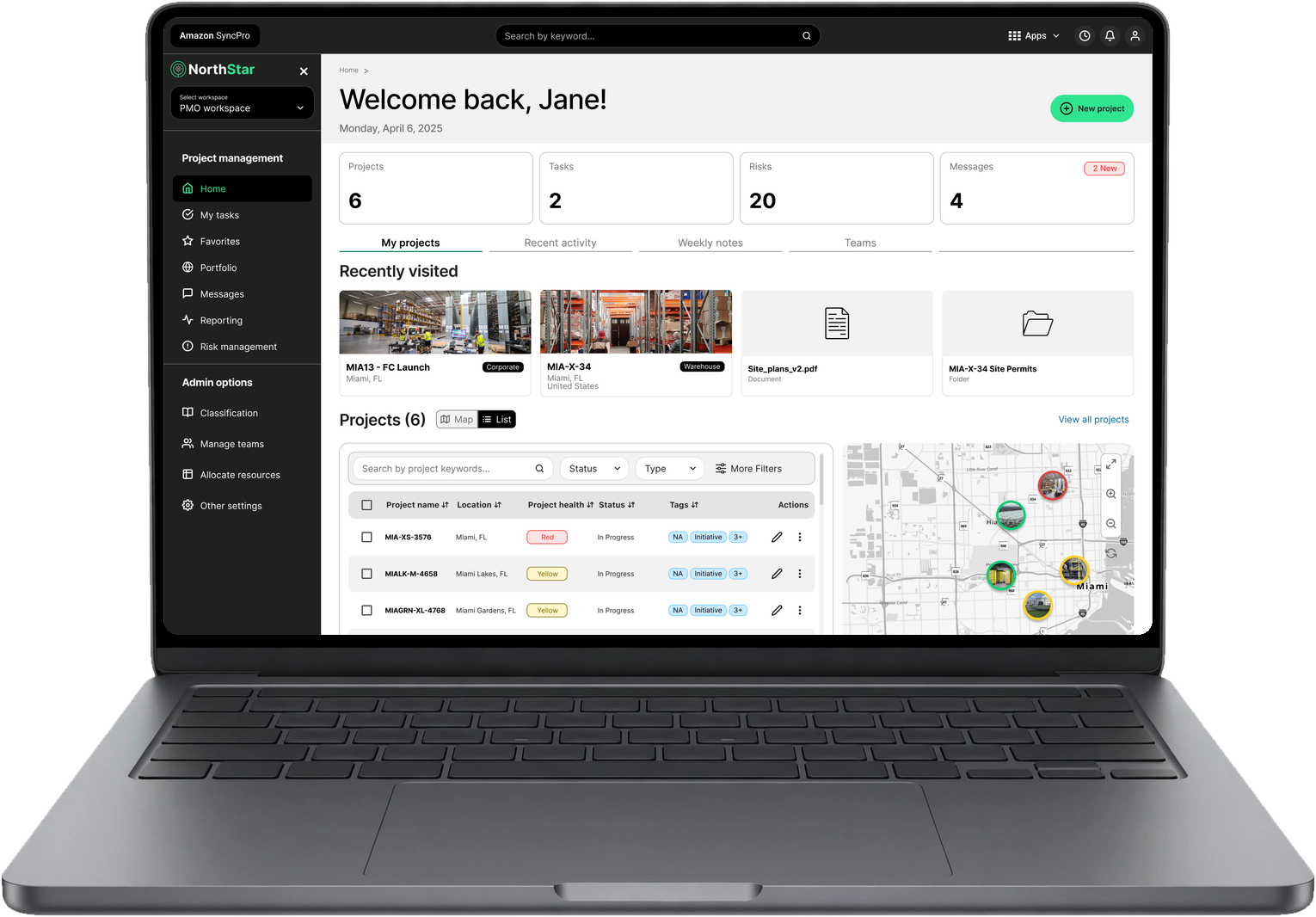
A 0→1 enterprise platform that replaced fragmented workflows with one system for tracking work, sharing updates, and reporting project health.
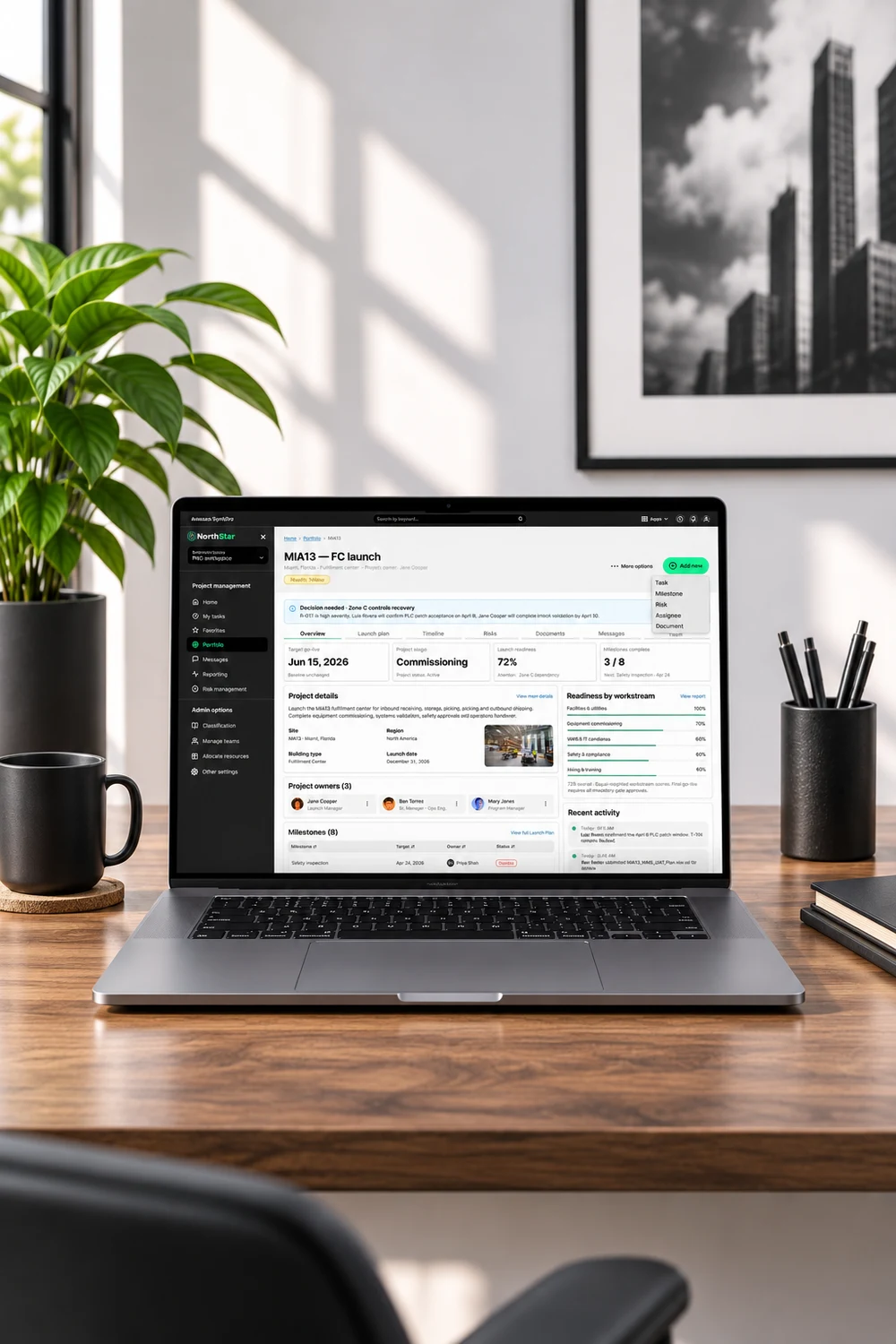
Project details
For NDA confidentiality purposes
This case study uses generalized language, and mock data to
protect proprietary information while preserving the design
process and outcomes.
 For NDA confidentiality purposes
The problem
Every team ran program management its own way, in its own preferred tool, causing delays, bad data, and leadership decisions slowed by multiple report formats.
What I did
I ran 50+ interviews, mapped the jobs to be done, and rebuilt the information architecture from scratch, keeping the design aligned to the org-wide roadmap.
Timeline
Amazon, 2024–2026. I led the UX for the redesign, working with the product and engineering teams behind the tool. The MVP shipped in twelve months.
What changed
CSAT rose from 3.5 to 4.38. Monthly users grew steadily from 1,000 to 4,000 in three quarters. Workflows take fewer clicks, and Excel workarounds disappeared.
UX impact
The problem
Every team ran program management its own way, in its own tool, causing delays and bad data, so we needed one system to track work, share updates, and report project health.
What I did
My job was to turn that fragmentation into one system, without forcing every team into a workflow that didn't fit how they worked.
I led design from discovery to launch, shaping one system for projects, updates, and reporting across three user types.
- Co-led research and workshops with product managers
- Mapped user journeys and workflows
- Prototyped and validated concepts with users
- Shaped MVP scope as priorities shifted, alongside product and engineering
UX Methods
I started where I always start: with the people doing the work, in their actual context.

Stakeholder management
NA, EU, emerging countries
50+ interviews
Remote and in person
Group sessions
Co-led with product managers
Contextual inquiry
Users shared their screen
Competitor analysis
Pain points
Across 50+ interviews and three regions, the same four problems kept surfacing. We decided to build internally. That build became NorthStar.
Manual repetitive updates
Teams copied the same status across multiple tools with no single source of truth, creating unnecessary rework every cycle.
Terminology mismatches
Different teams used different language for the same work, making unified reporting to leadership inconsistent and unreliable.
No dependency visibility
When one team's work unblocked another, there was no way to know. People found out by asking around or missing deadlines.
Disconnected tools
Users toggled between several platforms to complete one workflow, creating friction and scattered, inconsistent data.
Synthesis & user outcomes
Pain points tell you what hurts. They don't tell you what people are trying to accomplish.
To better understand what users were ultimately trying to accomplish, I mapped their needs through a Jobs to Be Done (JTBD). This helped shift the focus away from features and toward the real outcomes users needed to achieve across planning, coordination, and execution.
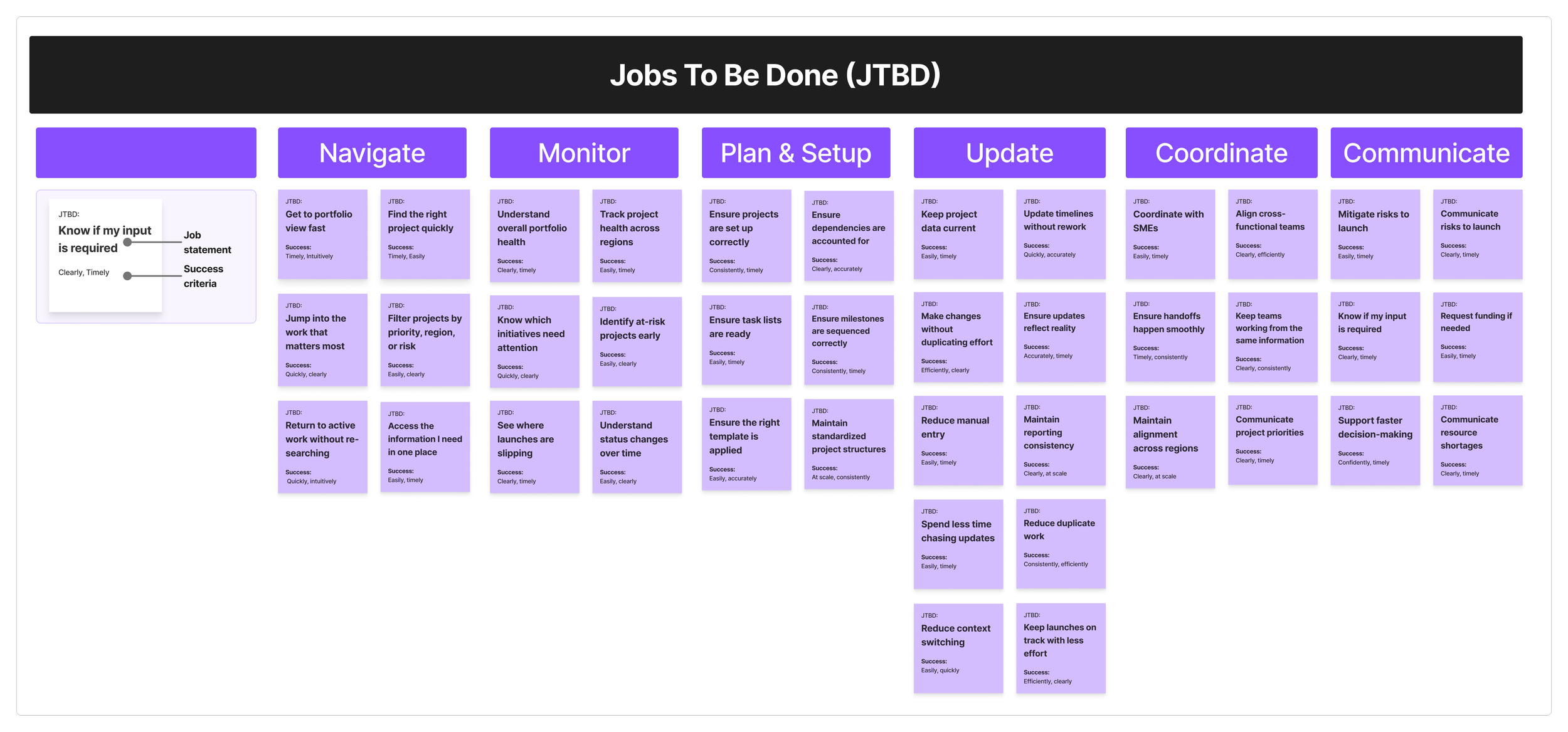
Mapping the persona
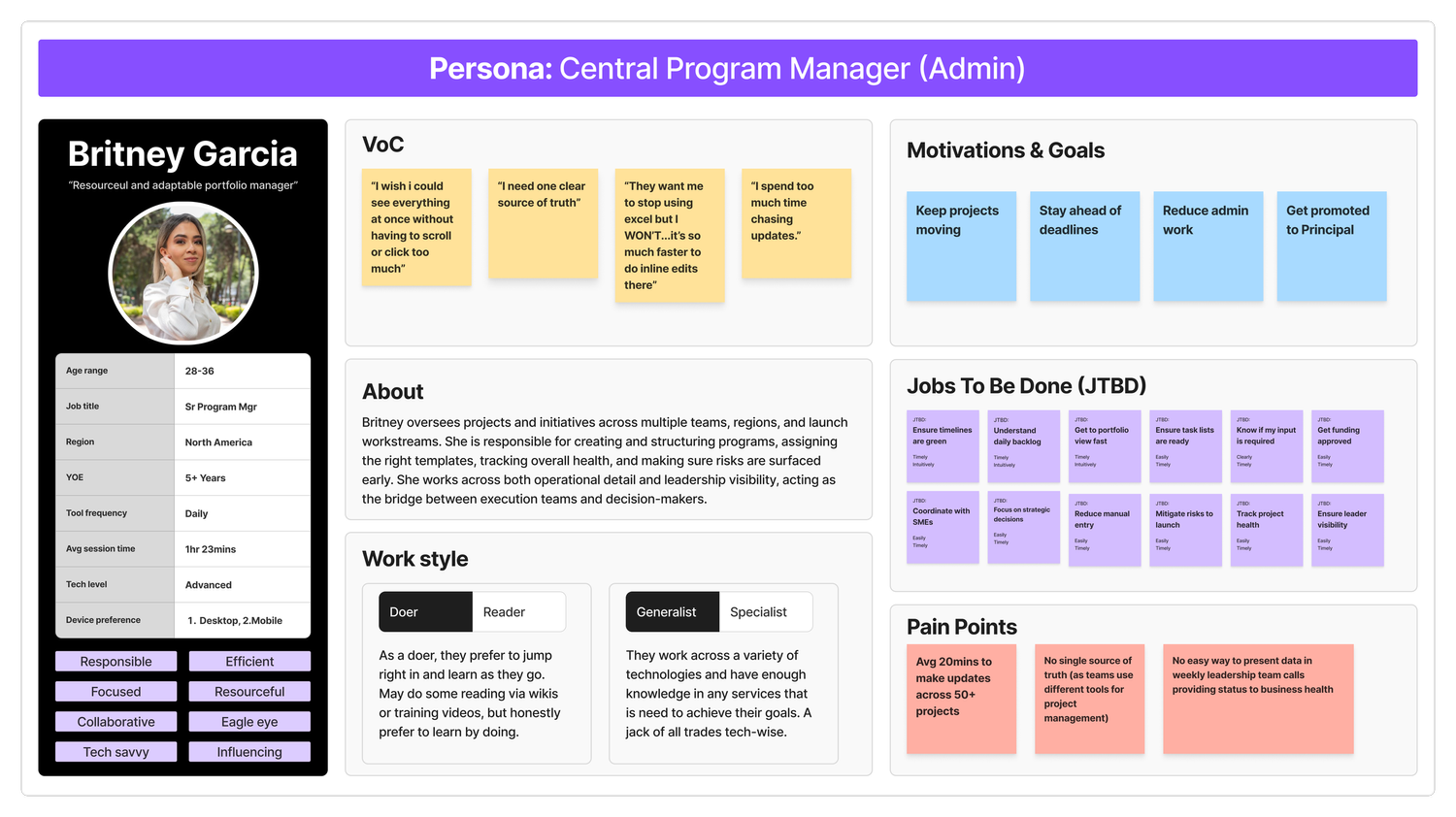
Three very different users came out of that work, and the product had to serve all three: the admins who run the system, the project managers who live in it, and the leaders who only read the health of it.
Three personas shaped the product:
- Central program managers Primary persona
- Project managers
- Leaders/viewers
Understand the user journey
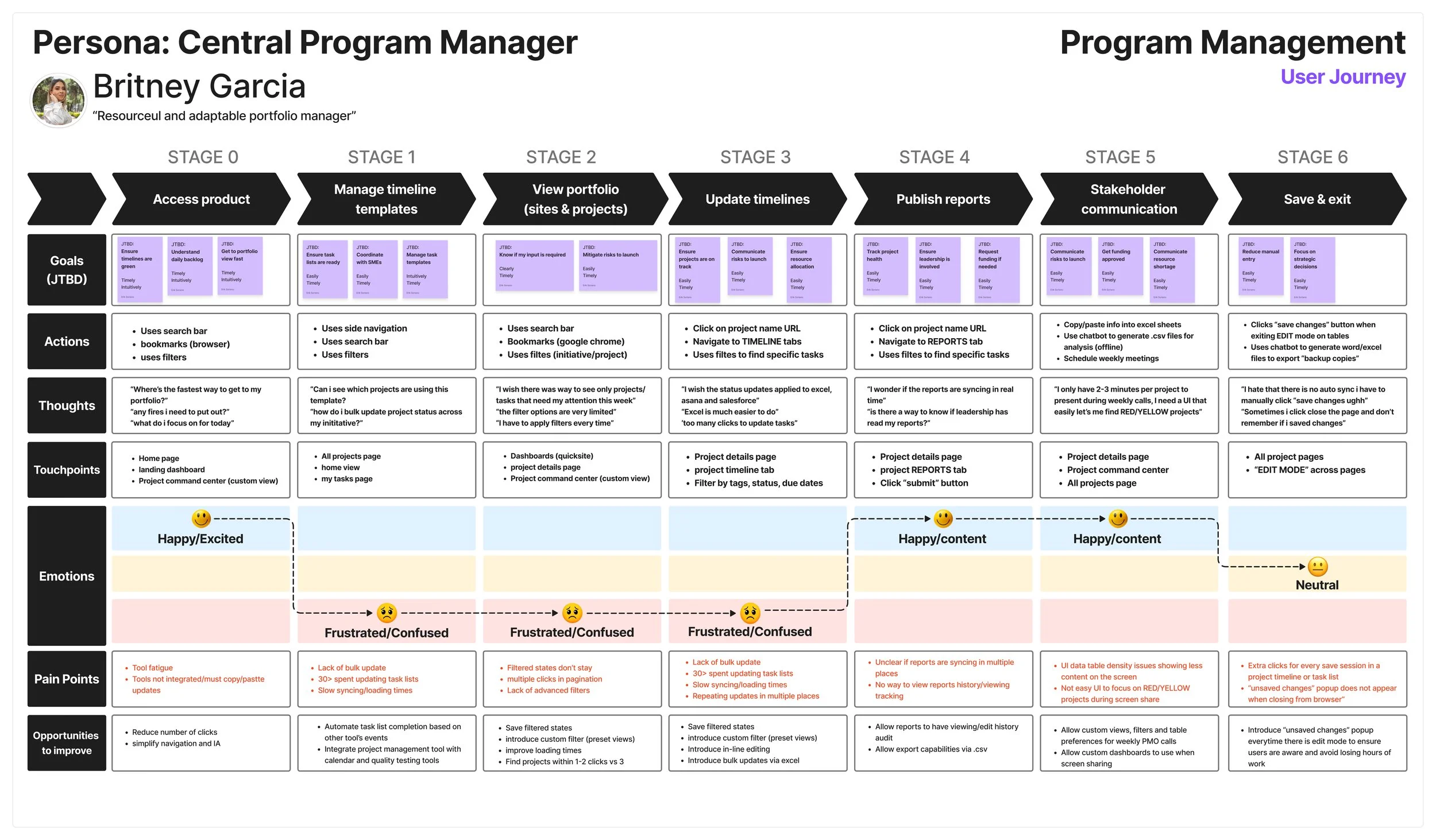
Then I followed the primary persona through one full cycle to find the exact moments where the old process broke down and where the new one had to hold.
After user research concluded, and we mapped the personas, we dived deep into the user journey to understand the gaps our new experience needed to fill.
The example below shows the primary persona's user journey.
We learned the outcomes. We understood the users. Now we needed to know how to build the experience.
Navigation and site map
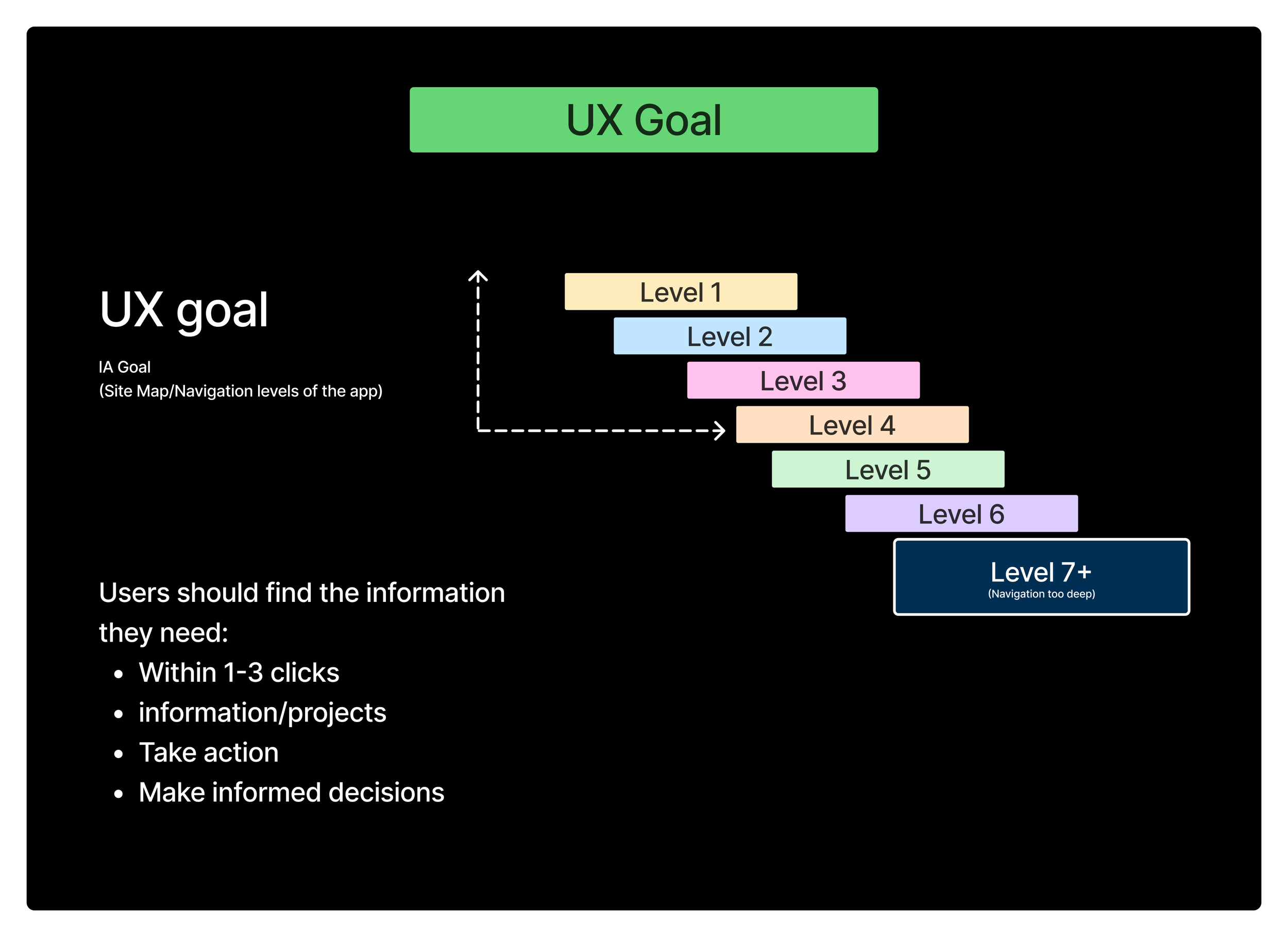
With the journey mapped, the structure came next: one home for every project, and every critical workflow within one to three clicks of it. NorthStar had to serve three very different user types while still handling the complexity of enterprise program management.
The navigation itself never changed between roles: same bar, same sidebar, same order. What changed was how much of it a person could see. Each persona only saw the items their job needed, so nobody scanned past tools they could not use. Less surface, less cognitive load.
The house analogy
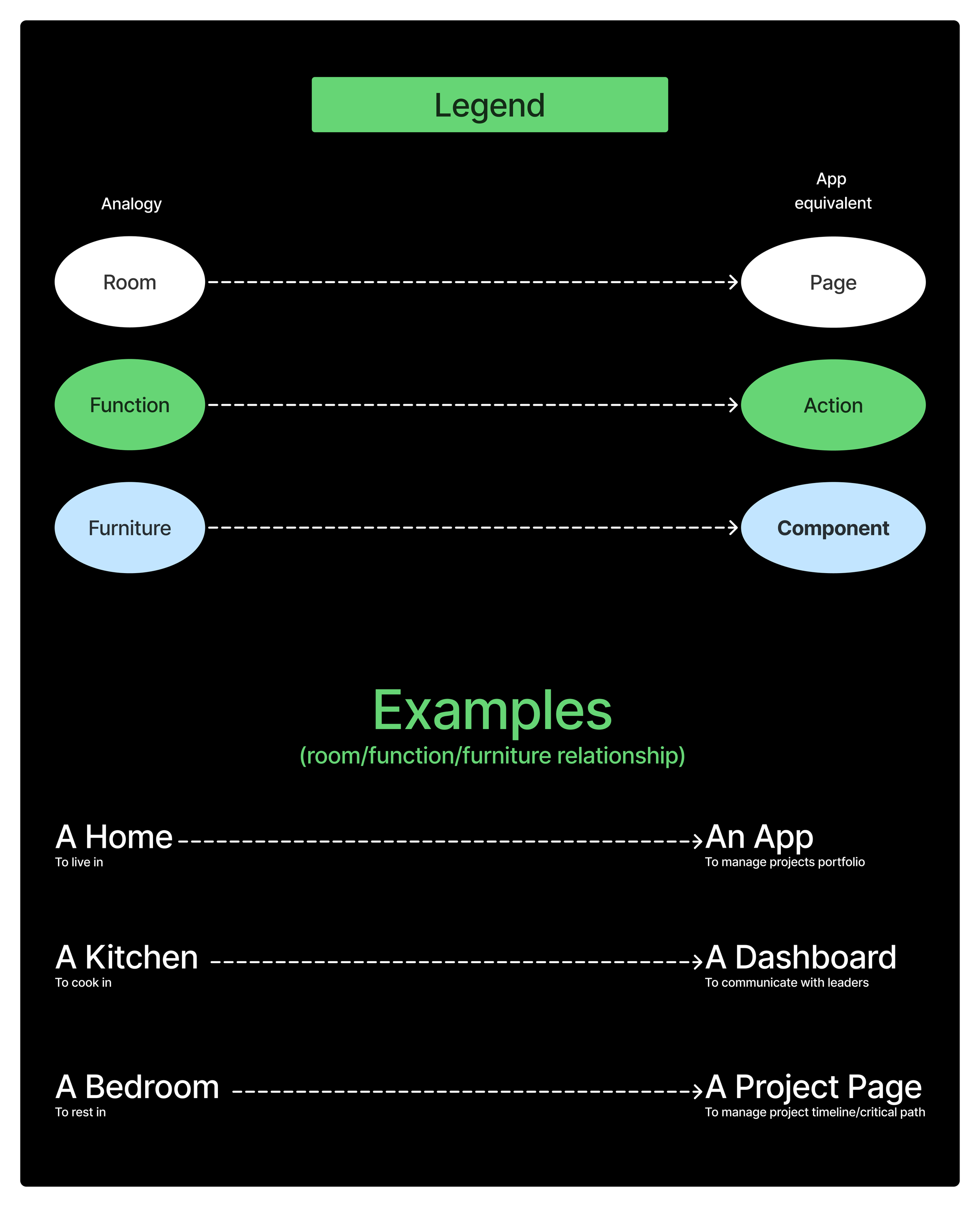
To communicate the IA structure across the team, I used a house analogy, where pages are rooms, actions are functions, and components are furniture. Every room exists for a purpose.
This framework helped:
Navigation depth goal
I kept every critical workflow within 1 to 3 clicks of the home page, so users could find a project, timeline, or task list without digging through menus.
Permission-based navigation
The site map came straight out of what we learned. The interviews and the jobs to be done showed the three personas were not doing the same work at different depths, they were doing different work. So instead of one tree trimmed down per role, each persona got a structure shaped around their outcomes: admins configure, project managers execute, and leaders read. One home, one order, but nobody carried navigation their job did not need.
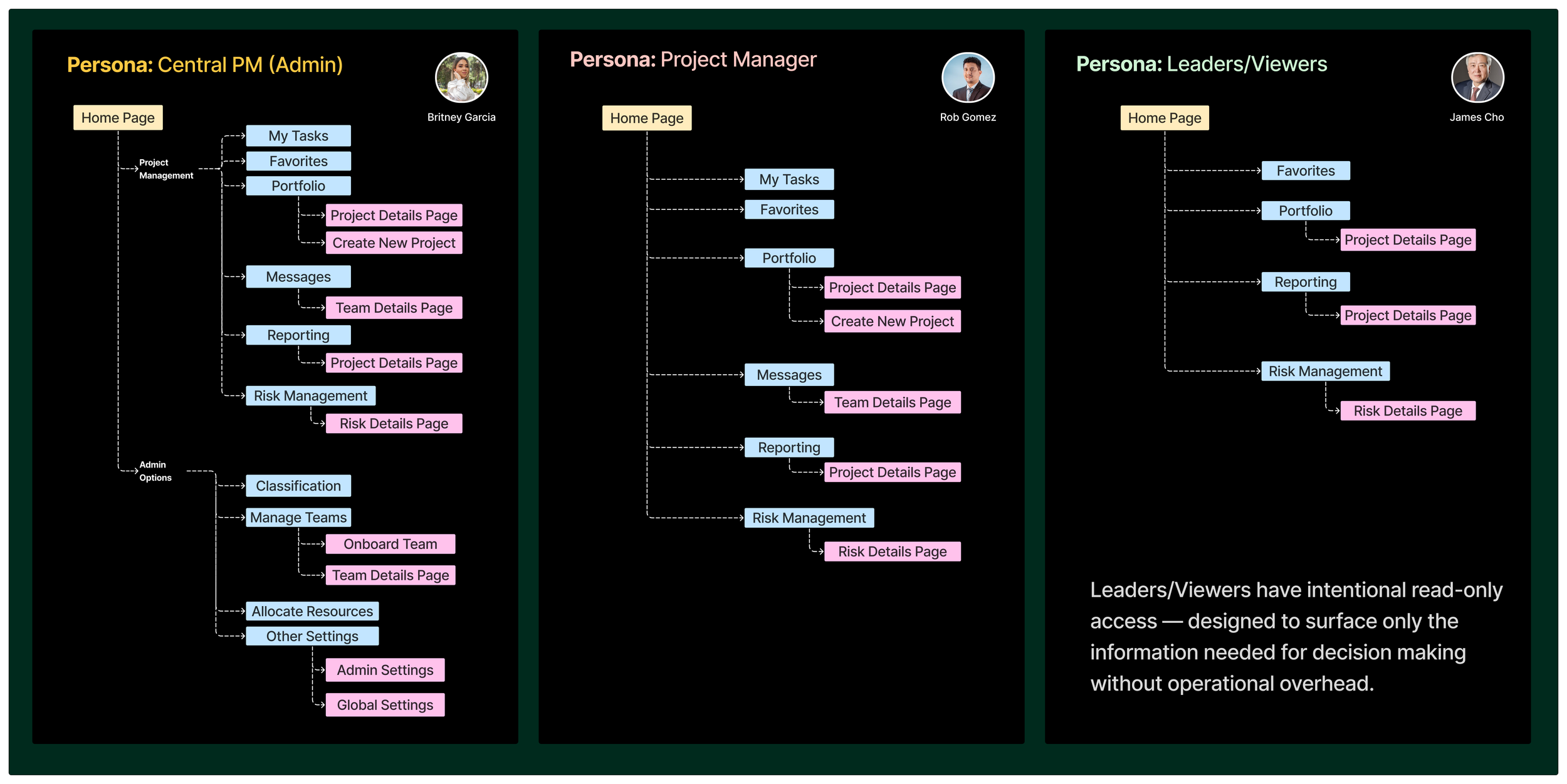
The opportunity was to create a unified system that improved visibility, reduced friction, and still supported the needs of different users.
Wireframes
This is what I’m allowed to showcase.
Note: All Amazon confidential data has been replaced with mock data for these designs.
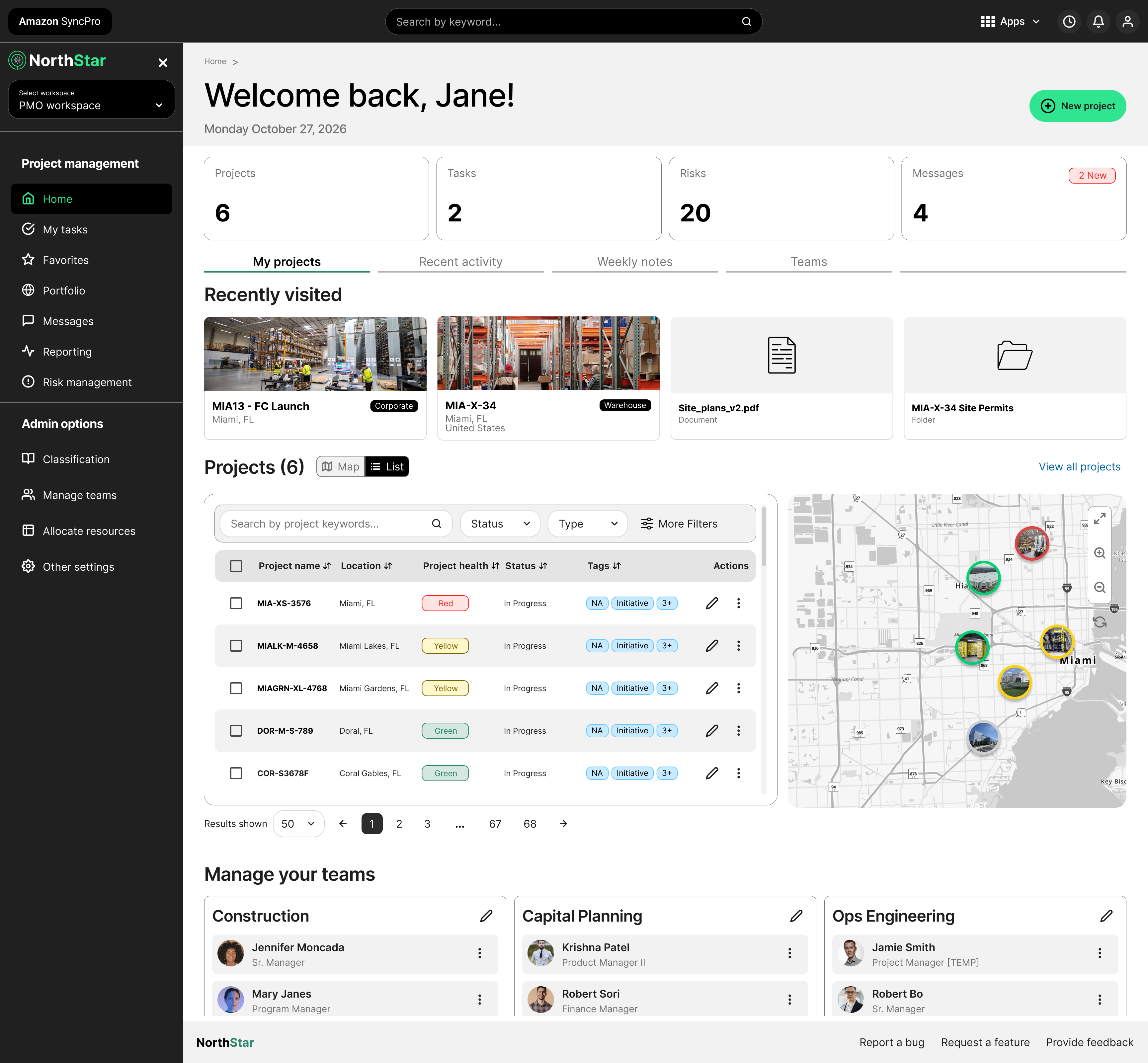
The landing page, a high-level view of every program and its status.
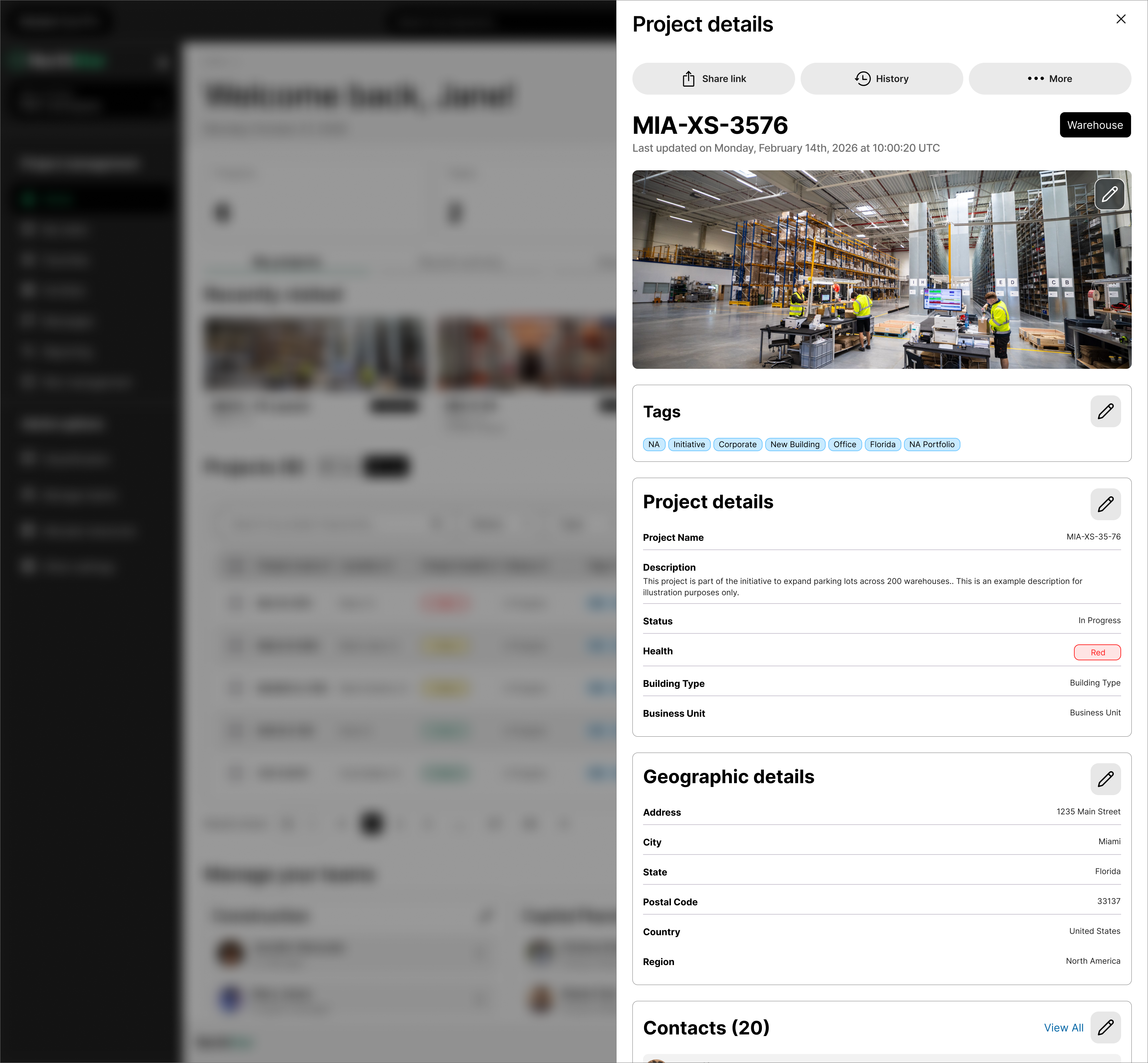
A quick way to view a program's details without losing context.
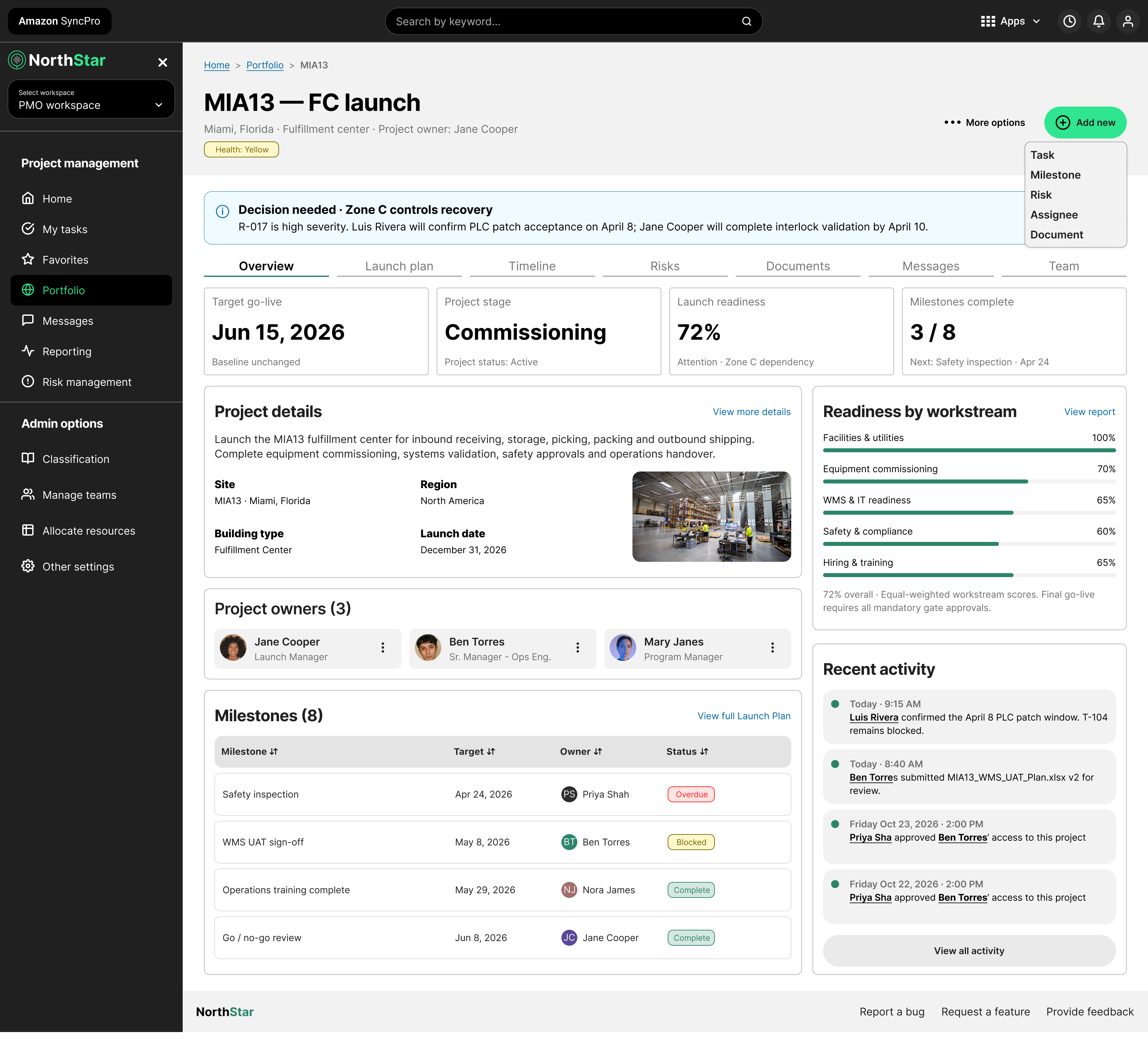
A deep dive into a program's deliverables, dependencies, and timelines.
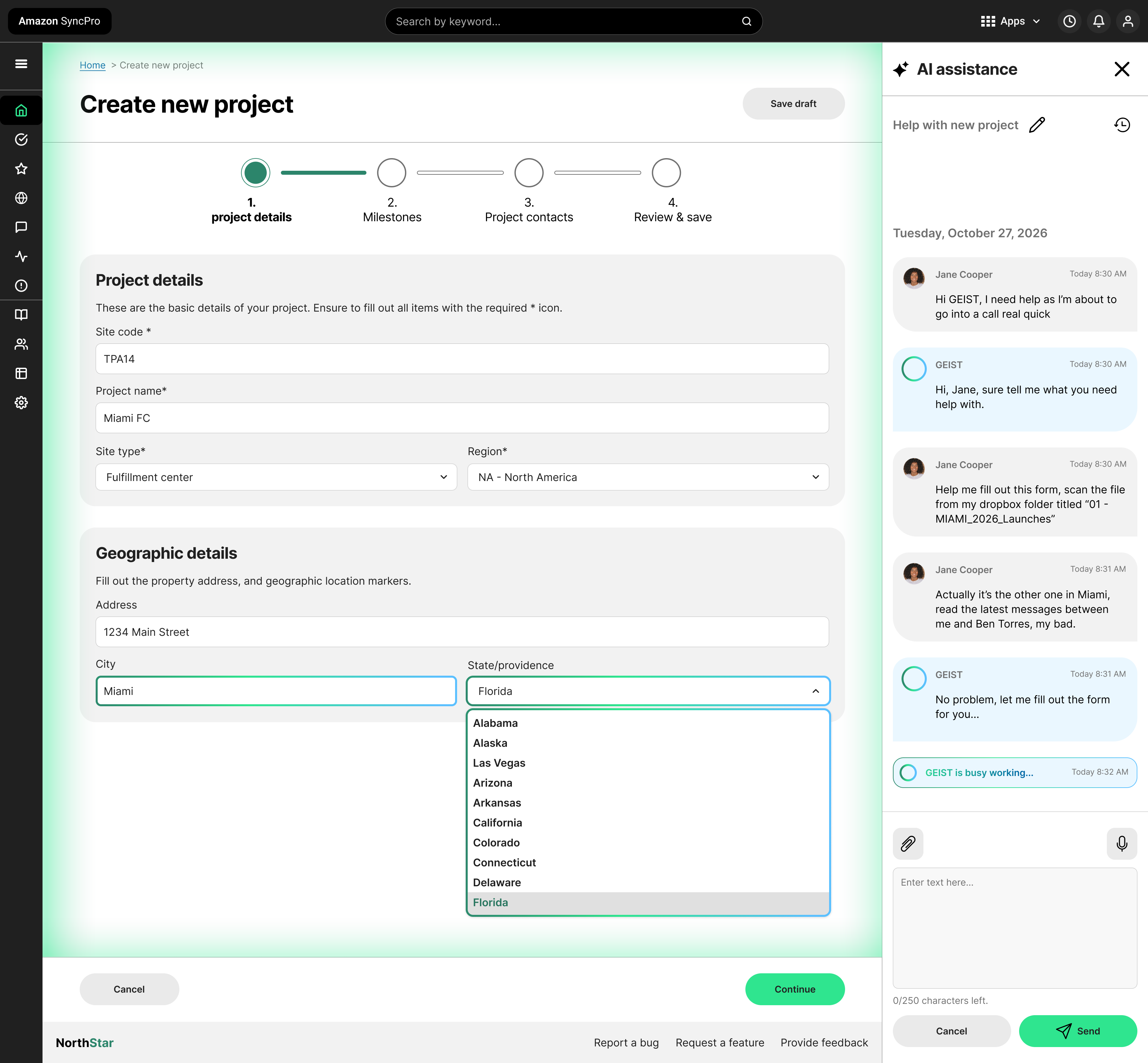
AI assistance helps fill out the new project form.
We built.
We measured.
We learned.
Results and impact
-
More consistent workflows
Bringing scattered tools into one platform gave teams one structured way to manage projects and share updates.
-
Higher adoption
Monthly users grew from 1,000 to 4,000 within three quarters of launch.
-
Clearer reporting
Standard dashboards made it easier for admins and leaders to see progress, risks, and project health.
-
Improved satisfaction
Post-launch feedback helped uncover usability gaps early. CSAT rose from 3.5 to 4.38 out of 5 over the first three quarters.
Lessons learned
NorthStar taught me that enterprise design is mostly about alignment. The hard part was balancing multiple user types, shifting product direction, and business priorities, then landing on something the team could realistically launch.
It sharpened how I define an MVP under pressure and use research to guide decisions. It also showed me that some of the most important improvements happen after launch, once real usage shows where the experience needs to change.